
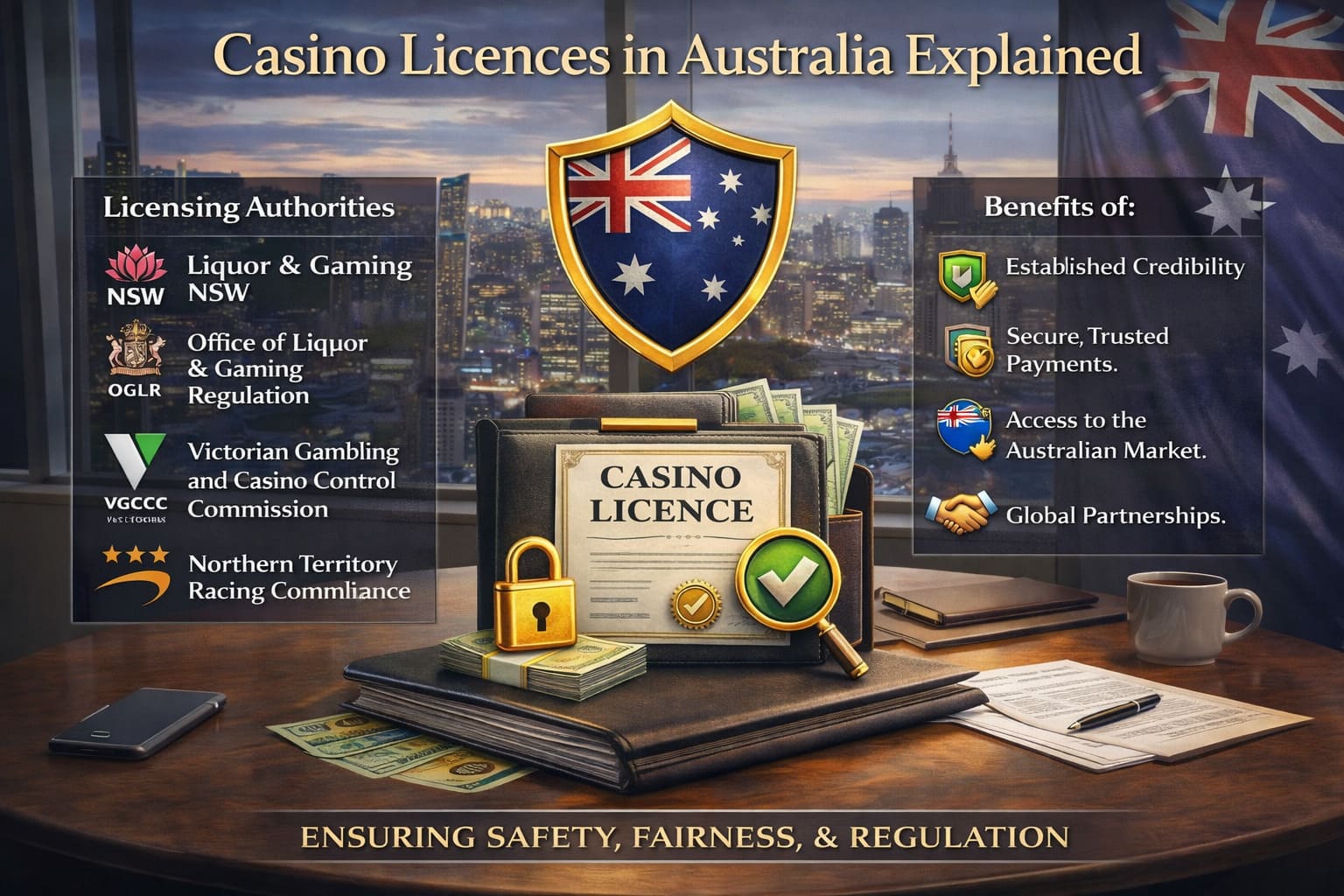
A tourist walks past The Star in Sydney and sees the “Licensed Venue” signage by the entrance. It looks reassuring—like a stamp that says: “This place is regulated, fair, and safe.” Later that night, she searches online for pokies and runs into dozens of websites claiming they’re “licensed in Australia.” Some mention a Northern Territory licence. Others throw in Malta or Curaçao. So which one actually matters—and does “licensed” always mean “protected”?
If gambling law in Australia has ever felt like a maze, you’re not imagining it. The Commonwealth (federal level) sets national rules for interactive gambling, but states and territories issue most licences and control most day-to-day regulation. A venue can be fully compliant in one state and face very different restrictions in another. And online gambling is the biggest source of confusion: online wagering is regulated, while online casino-style games are largely prohibited.
You’ll see that confusion reflected on review and info sites too. If you’ve searched on platforms like thepokies114, you’ve probably noticed mixed references to regulators, licences, and “legal” claims that don’t always align. That’s because Australia is deliberately multi-layered: the federal government sets certain boundaries, and each state/territory runs its own licensing framework for venues and many gambling products.
In this guide, we’ll make the map simple: who regulates what, what “licensed” realistically means for players, where the hard legal lines sit (especially for online casinos), and how operators stay compliant across a system that doesn’t work like a single national rulebook.
The Big Picture: Who Regulates Gambling in Australia?
Australia doesn’t have one national gambling authority. Instead, regulation happens on two levels: Commonwealth law (federal) and state/territory law. That split comes from how Australia’s federation works—states keep strong control over local industries, while the Commonwealth steps in where things cross borders or involve national communications and enforcement.
In practical terms, the Commonwealth focuses heavily on interactive gambling (online/telecom-based) through the Interactive Gambling Act 2001 (IGA). Meanwhile, most “real-world” licensing—casinos, pubs and clubs with gaming machines, lotteries, keno, and many wagering licences—comes from state and territory regulators.
The result is a patchwork that can still function well, but it’s easy to misunderstand. An operator can hold a valid Australian licence for wagering and still be prohibited from offering online roulette or online pokies. And an offshore operator can be “licensed somewhere” but still be offering illegal products to Australians under Australian federal law.
Federal Law: What the Commonwealth Controls (and What It Doesn’t)
The Commonwealth’s key piece of legislation here is the Interactive Gambling Act 2001 (IGA). It primarily targets providers, not players. In other words: it’s aimed at stopping companies from offering certain online gambling products to people located in Australia.
The IGA draws a clear line between prohibited interactive gambling services (casino-style online games like roulette, blackjack, and online pokies), and regulated online wagering (sports and racing), which can be offered online—but only by operators holding an appropriate Australian state/territory licence and meeting federal restrictions (including limits on most online in-play betting).
Enforcement sits largely with ACMA (the Australian Communications and Media Authority), which can act against illegal offshore operators through disruption and compliance measures, including website blocking. The IGA doesn’t replace state systems; think of it as the “national boundary layer” that sits above local licensing.
States and Territories: The Licensing Reality on the Ground
Walk into a casino, a club, or a hotel with pokies and the licence you’re looking at is almost always issued and enforced by a state or territory regulator, not Canberra. Land-based gambling is overwhelmingly local in Australia, and that’s why the rules can feel inconsistent from one place to another.
Each jurisdiction has its own framework: different regulators, different legislation, different caps and venue rules, and different harm-minimisation settings. The upside is flexibility—states can tailor rules to local impacts. The downside is obvious: consumers and even operators can struggle to understand what’s allowed where, and why.
What “Licensed” Means for Players (A Practical, No-Hype Interpretation)
“Licensed” is best read as: this operator is inside a regulator’s system. That usually implies background checks, minimum standards, audits, responsible gambling obligations, and a pathway for complaints. It does not mean “risk-free,” and it does not guarantee you’ll never face disputes or delays. A licence is closer to a seatbelt than a magic shield: it doesn’t prevent every crash, but it changes how accountability works when something goes wrong.
| Player question | What to look for | What it suggests | Common misconception |
|---|---|---|---|
| “Is this legal for Australians?” | Australian state/territory licence for wagering/lottery; product matches the licence | Operator is inside the Australian regulatory framework | Offshore licences don’t make online casino games legal under Australian federal law |
| “Are payouts guaranteed?” | Clear terms, accessible support, established operator history | Better accountability and complaint pathways | A licence doesn’t guarantee instant withdrawals or eliminate disputes |
| “Are games fair?” | Audits/testing, published RTP info (where applicable), compliance record | Games meet technical standards; house edge still applies | “Fair” doesn’t mean you’ll break even over time |
| “If I complain, does the regulator fix it?” | Clear dispute process and regulator contact details | A structured escalation path exists | Not every complaint ends with a refund; outcomes depend on facts and rules |
| “Can I self-exclude?” | BetStop for licensed online wagering; venue-based self-exclusion for land venues | Harm-minimisation tools are built into compliance | Self-exclusion still depends on proper enforcement and user follow-through |
Pokies in Venues: Why the State/Territory Layer Matters So Much
Pokies (EGMs) are regulated at the state and territory level, and the differences are not cosmetic. Limits, venue rules, density controls, payout processes, and harm-minimisation settings change depending on where you are. That’s why the “pokies experience” can feel noticeably different between NSW, Victoria, Queensland, and Western Australia.
Online Casinos vs Sports Betting vs Lotteries: Same Word, Different Legal Status

“Online gambling” gets used as an umbrella phrase, but legally it’s not one bucket. Product type is the first question you should ask, because that determines what can be licensed and offered.
| Product type | Regulatory layer | Commonly allowed / restricted |
|---|---|---|
| Online casino games (roulette, online pokies, blackjack) | Federal IGA boundary | Generally prohibited to be offered to Australians, regardless of offshore licensing |
| Online sports betting and race wagering | State/territory licence + federal IGA restrictions | Allowed if appropriately licensed; in-play betting online is restricted in many cases |
| Lotteries | State/territory licensing | Generally legal; often operated under long-term licensing arrangements |
| Keno | State/territory licensing | Common in venues; online availability varies by jurisdiction |
| Poker | Varies | Social poker is usually fine; commercial online poker is typically constrained under the IGA |
The headline point is simple: online casino-style games are the hard line. Offshore sites may accept Australians, but that doesn’t place them under Australian consumer protections, and it doesn’t change the fact that offering those products to Australians is generally prohibited under the IGA.
Enforcement and Consumer Protection: What Happens When Things Go Wrong
Licensing only matters if enforcement exists. At the federal level, ACMA can act against illegal online gambling providers through disruption and compliance measures. At the state/territory level, regulators can investigate breaches, impose sanctions, enforce responsible gambling obligations, and—when necessary—strip licences or force reforms. The key consumer reality is this: the strongest complaint pathways exist when you’re dealing with an operator that is actually inside the Australian licensing framework.
Red Flags vs Green Flags When You See “Australia Licensed” Claims
Not every licensing claim is equal. Some are meaningful; some are marketing fog. Here’s a quick sanity-check without turning into a full-time investigator.
Red flags:
- Online casino games claiming an Australian licence: if a site offers online pokies/roulette/blackjack and says it’s “licensed in Australia,” treat that as a major warning sign.
- Offshore licences framed as “Australian legal”: Malta/Curaçao licensing does not override Australian federal restrictions on offering online casino games to Australians.
- No regulator name or licence number: “Fully licensed” without specifics is often a tell.
- No real complaints pathway or support: regulated operators don’t hide contact options.
Green flags:
- Clear Australian state/territory licence details: regulator name, licence number, and product type that matches what’s offered.
- Responsible gambling tools are easy to find: self-exclusion info, limits, support links.
- Transparent terms: not vague, not designed to confuse, and consistent across pages.
A Quick Licence-Check Checklist (Fast, Practical)
- Identify the product: wagering, lottery, venue gambling, or online casino-style games.
- Find the licence disclosure: footer or “About” section—regulator + licence number + jurisdiction.
- Cross-check official sources where possible: verify listings via the relevant regulator/authority.
- Match the licence to the product: a wagering licence does not cover online casino games.
- Check harm-minimisation tools: self-exclusion, limits, and support pathways should be visible and usable.
And if you’re reading about an operator through a review page like thepokies 114 net in Australia, treat it as a starting point—not final proof. Reviews can give context, but official licence verification is what actually settles the question.
Conclusion
Australia’s gambling licensing system is multi-layered on purpose. The Commonwealth sets boundaries through the IGA, especially around interactive gambling. States and territories do most of the licensing and enforcement for venues and many gambling products. That structure creates complexity, but it also reflects how Australia is governed.
For players, the most useful mindset is this: a licence is a signal of accountability, not a promise of perfection. It tells you who the operator answers to and where complaints can go. But it doesn’t remove all risk—especially when the operator is offshore or the product sits outside what Australian law allows.
Informed players are better protected than players who assume a “licensed” label tells the whole story.